
The Indian Art of Living: Craft, Objects and the Making of Timeless Indian Luxury Interiors

There is a particular quality to an Indian luxury interiors and homes that cannot be manufactured. It comes from objects with history, from materials that reveal the hand that shaped them, and from interiors that feel collected rather than decorated.
For centuries, the Indian home has been a place where craftsmanship and everyday life existed together. Carved wood, inlaid surfaces, handwoven textiles, metalwork, stone and painted details were not merely decorative additions. They were part of the architecture of living.
Today, as contemporary interiors become increasingly refined and restrained, this philosophy is finding a new relevance. The most compelling luxury homes are not necessarily the ones filled with the most objects. They are the ones where every object has a reason to exist.
Craft as the Foundation of Luxury
Luxury has traditionally been associated with rarity, provenance and exceptional materials. But increasingly, true luxury is also defined by something far less tangible: human craftsmanship.
A handcrafted piece carries the evidence of its making. The subtle variation in a carved surface, the depth of an inlay, the character of natural wood or the irregularity of a hand-finished detail gives an object a presence that mass production cannot replicate.
This is particularly significant in Indian craftsmanship, where techniques have evolved through generations of artisans and workshops.
From intricate wood carving to bone and mother-of-pearl inlay, Indian decorative arts possess a vocabulary that is both deeply rooted and remarkably adaptable. In a contemporary setting, these techniques need not feel traditional in the conventional sense. When thoughtfully proportioned and placed, they can become remarkably sophisticated expressions of modern luxury.
The Beauty of a Collected Home

The most memorable luxury interiors rarely appear as though they have been purchased in a single afternoon.
They evolve.
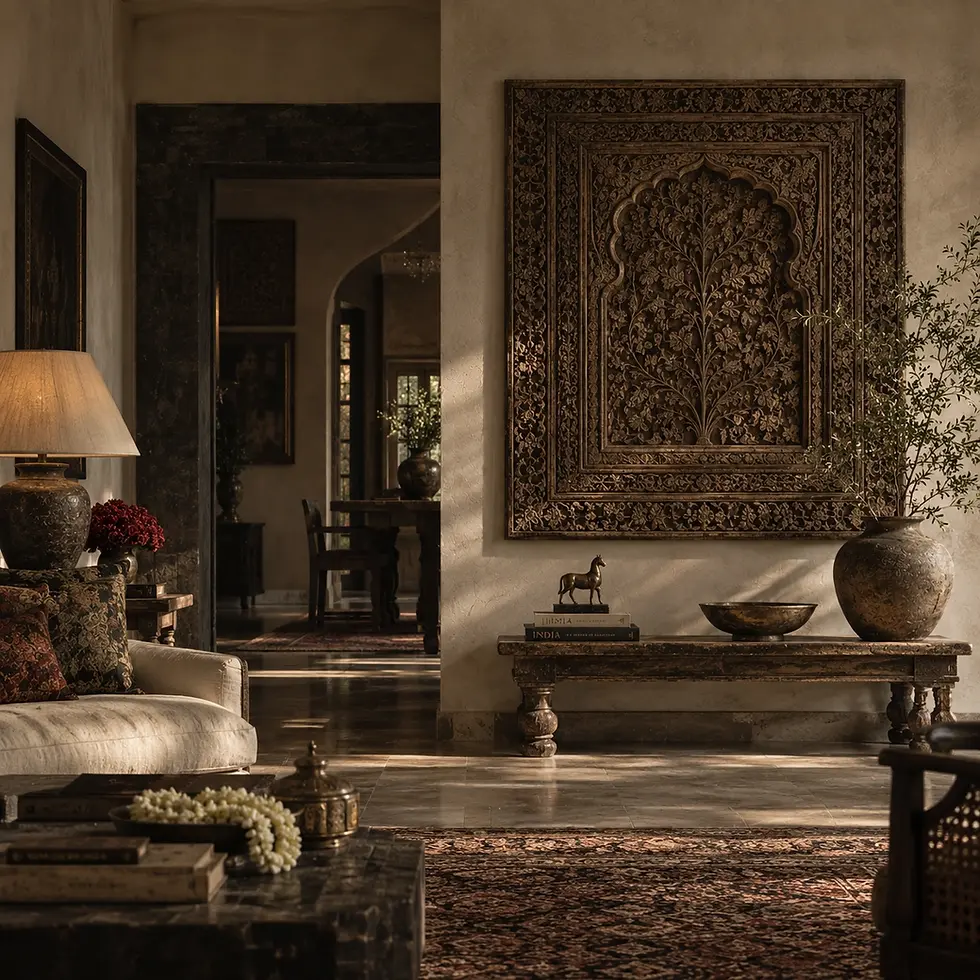
A sculptural console might sit against an otherwise quiet wall. An ornate mirror may become the unexpected focal point of a restrained bedroom. A carved panel can introduce texture into an architectural interior without overwhelming it.
This is the art of collecting rather than decorating.
For discerning homeowners and luxury interior designers, the objective is often not to create a room that looks perfect in the moment, but one that becomes increasingly personal with time.
The distinction is subtle but important.
A decorative object fills space. A considered object creates atmosphere.
Indian Craft in Contemporary Interiors
There was once a tendency to associate Indian craftsmanship with heavily ornamented interiors—palatial rooms, elaborate textiles and layers of traditional decoration.
The contemporary Indian home is moving beyond that vocabulary.
Today, handcrafted Indian furniture and décor can exist beautifully within spaces defined by limestone, natural timber, muted plaster, architectural lighting and restrained palettes. The contrast is powerful: an intricately carved surface against a quiet wall, an antique-inspired form within a modern room, or a highly detailed mirror surrounded by simplicity.
This approach allows craftsmanship to become the protagonist.
For luxury interior designers, it also creates an opportunity to introduce cultural depth without compromising a contemporary aesthetic. A single exceptional piece can provide the visual and emotional punctuation that an otherwise minimal interior requires.
Objects With a Sense of Place
The most valuable objects in a home are not always the most expensive.
They are the ones that make the home feel unmistakably its own.
A handcrafted piece can carry a sense of place—of Rajasthan, Mughal ateliers, Indian palaces, traditional workshops and centuries-old decorative traditions—while still feeling entirely at home in a modern residence in Mumbai, Delhi, London or New York.
This is where Indian design has an extraordinary advantage.
Its visual language is rich enough to create drama, yet its craftsmanship is sophisticated enough to be interpreted through a contemporary lens.
The result is not nostalgia. It is continuity.
Designing for the Next Generation
Perhaps the most compelling aspect of handcrafted furniture is its potential to outlive the moment for which it was purchased.
Trends change. Interiors evolve. Homes move from one generation to another.
A beautifully made console, mirror, cabinet or carved panel can acquire meaning as it ages. Its value becomes less about its original purpose and more about the life that has surrounded it.
This is the essence of an heirloom.
In an age of increasingly disposable consumption, choosing a handcrafted object is also a conscious decision to buy with permanence in mind.
It is a belief that a home should contain fewer things, but better things.
The New Indian Luxury
The future of Indian luxury interiors does not lie in reproducing the past.
It lies in interpreting it.
The opportunity is to take the extraordinary craftsmanship of India and place it within a more considered, contemporary world—one where proportion, material, restraint and provenance matter as much as ornament.
At The Jodhpore, this philosophy informs the way we think about handcrafted furniture and luxury home décor: not as pieces designed simply to complete a room, but as objects intended to become part of its story.
Because the Indian art of living has never been about decoration alone.
It is about surrounding oneself with things that carry beauty, craftsmanship and meaning—and allowing them to become part of the life of the home.
The finest interiors are not merely designed. They are collected, lived in and, eventually, remembered.


Comments